
Blue goes green; Longtime Holland business to run on solar power
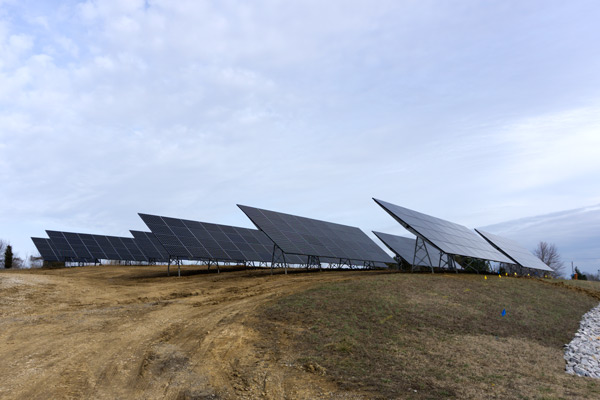
The greenest thing at Blesch Bros is the new solar panel array on a hill north of the farm equipment company on State Road 161.
Kevin Lubbehusen, co-owner of the nearly 60-year-old Holland company that carries New Holland and Massey Ferguson farm equipment, should make the switch over to the new power source next week.
“This is our way of going green if you will,” Lubbehusen said. “We recycle a lot at the shop because we want to keep this stuff out of the landfills. This is just another step in the right direction.”
 According to Lubbehusen, he started talking about solar power with Jim Straeter while the two were attending an event in Tennessee over three years ago.
Straeter owns a New Holland dealership in Rochester, Ind. where he sells the arrays through his other company, Ag Technologies.
When Lubbehusen got a little more serious about a year ago, Straeter pointed him towards a grant through the USDA that was available for businesses to install the systems.
After being awarded the grant, construction finally began on the frames earlier this month. They shot up pretty quick and created a stir in the Holland as residents speculated on what the new construction was intended for.
In good fun, Luebehusen and company played along. A Facebook post on Feb. 16 featuring a picture of the new construction simply said the new display racks were coming along nicely.
A few days later, another post joked the new addition could be giant ping pong tables or teeter-totters.
With the panels installed earlier this week, the system is easily visible from State Road 161. Once Vectren signs off on the installation, the 3,040 square feet of panels will start providing power to the nearly 10,000 square foot Blesch Bros building. The 7 kilowatts of electricity produced by the system should zero out the company’s electrical bill.
The savings will take about seven years to pay off the initial cost of the system. The solar arrays have a 30-year lifespan and come with a 25-year warranty. According to Straeter, the panels are durable enough to take a hit from a piece of one-inch hail.
Straiter owns a patent on the system’s unique ability to be tilted by hand. They are adjusted four times a year as the sun’s angle changes in the sky with the seasons. The adjustment increases the overall efficiency of the system.
“That is critical,” Straeter said. “It keeps the efficiency of those panels at 18 percent.”
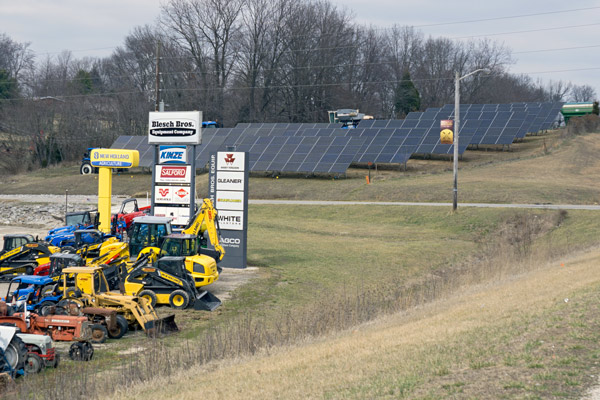 According to Straeter, the solar panels don’t just stop the electric meter from turning, “it goes backwards.”
With a tax credit for his business, the cost of the system broke down as an electrical cost equals 2.7 cents per kilowatt hour. That compared to the 12 cents per kilowatt hour Lubbehusen pays Vectren. Using solar, he hopes to cut out the $900 to $1,400 monthly electrical bill at Blesch Bros.
“I sorta feel like a guinea pig,” Lubbehusen joked. “I sorta stepped out on a limb, but I had a lot of good people helping me. We are looking at it long-range. We are just like farms, we have to invest in equipment and people.”
He sees solar as a great way for farms to cut costs. “Anyone that uses consistent energy would benefit from these,” he said. “Dairy farms and turkey operations would really benefit from this.”
He will likely start selling the systems but for now, Blesch Bros is the first company in the area to adapt the technology.
“I think it is a win-win for everybody,” he added. “It’s clean. In my opinion, it’s a wonderful neighbor. There’s a lot of pluses to it.”
