
School board hears options for damaged NE Intermediate School gymnasium
The Northeast Dubois County school board heard two options for renovating the damaged gym at the intermediate school Tuesday evening.
NE Intermediate school was damaged and closed after a tremendous deluge of rain overpowered drainage in Dubois. Subsequently, the corporation closed the gym and cafeteria as assessments were completed to determine the building’s fitness for use. The damage to the gymnasium was found to an extent that rendered it unusable for activities.
In September, the school board hired the Indianapolis architectural and engineering firm Schmidt Associates to complete structural assessments and present options for the gym’s future. The firm presented their findings and recommendations at Tuesday’s meeting.
First, Allen Jacobsen, civil engineer, gave an assessment of what occurred on Monday, August 30, 2021. Sitewise, he determined about 110 acres drain into the area that affected the intermediate school with the majority of that drainage area to the northeast of the property.
He explained that according to the date he was able to collect, more than seven inches of rain fell in a little over an hour. He said this amount of rainfall in that period of time would be considered a thousand-plus-year event by NOAA estimates.
Jacobsen said the storm drain traveling through the school property underneath the walkway between the two building before connecting to Vine Street is built to handle a 50 to 75-year event; which is up to Indiana’s standards.
“An extreme event,” said Jacobsen about the rainfall. “We simulated that storm for the watershed and obviously, that storm overwhelmed the capacity of that pipe.”
Jacobsen explained as water overwhelmed the storm drain, it began attempting to run through the notch under the walkway. However, it quickly overwhelmed its capacity as well. Subsequently, this forced the water to pool around the northern side of the building where it eventually forced its way into the basement of the gymnasium.
During planning and input sessions, mitigating another rainfall event that would damage the building was identified as the number one priority. To do so, Jacobsen identified three options.
The first option would be to increase the drainage capacity of the storm drain lines running through the school property and along the streets.
The second option would be to create a dry retention basin to catch excess water runoff and then allow it to drain slowly. Jacobsen said the best site to create the retention basin is northeast of the building where the softball field is. He added that this would still require additional storm drainage modifications because the basin would not have enough capacity to protect the school by itself.
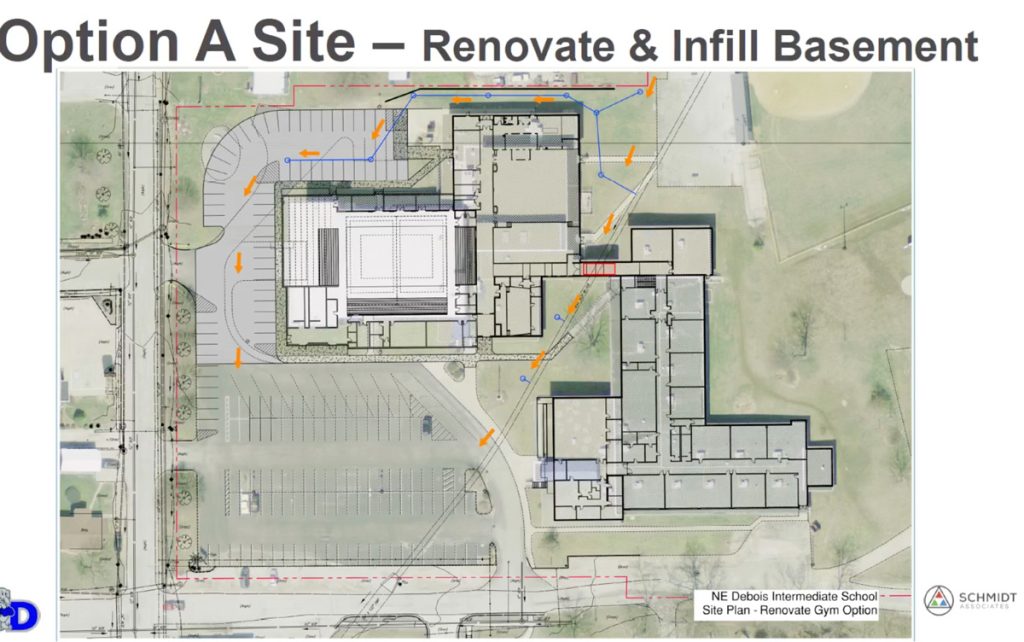
Jacobsen and the team recommended the board consider the third option. He explained they would create flood protective grading around the building to allow water to be redirected to the north and then to the west side before flowing south. To adjust the flow, a retaining wall would be added to the north side of the building to create a conduit for water to flow. This redirection and grading would also lower the amount going through the notch.
To do so, Schmidt Associates recommended the basement of the gymnasium be filled and the gymnasium floor be lowered to grade. Along with that, the school parking lot would be expanded and wrapped around the north of the building to provide a graded area falling away from the building. On the plus side, this would also add about 51 additional parking spaces.
In regards to the gym, the firm presented two options. Before showing those options, Sean Abercrombie, the architect on the project, explained that “everything stands on the shoulders of what Alan just talked through. Job one is being able to mitigate the storm water so that never happens again,” he said. “We have a firm belief we can do that.”
He told the board the existing 1949 gym is structurally intact — that thing could withstand a nuclear bomb, he said. There are interior damages but the bones of the structure are good.
The first option he outlined involved removing the added structure (identified as the 1951 addition) on the front of the ’49 building and then infilling the basement. They would lower the gymnasium floor down to be level with the cafeteria floor before adding structure to the north, south and west of the original building to create room for the school’s identified needs.
“Because of the age and the condition of the original gym as soon as we touch it, we will have to make significant changes,” Abercrombie said referring to ADA compliance issues.

The second option would be to raze the existing structures and build from scratch.
Both options addressed issues the school has with capacity, storage, activity areas and traffic flow through the building while bringing it into compliance with ADA standards in its bathrooms and locker rooms.
Infilling the basement is included in both options due to the problems with water infiltration as well as the continued maintenance of a largely unused elevator. To accommodate the lost storage from the basement, Anna Marie Burrell, project manager, explained the both plans include the addition of about 6,000 square feet of space.
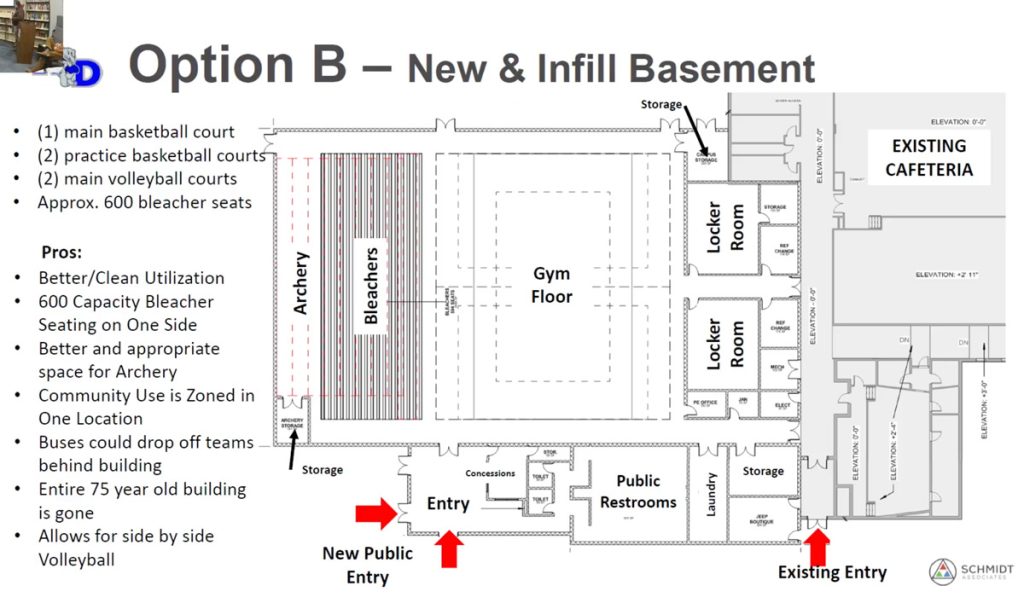
Regardless of which way the board decides to go, the water mitigation approach is essentially the same with some changes to the landscaping around the new gym compared to saving the 1949 structure.
“We feel this is the most economical and most holistic way to address the drainage issues you saw last August,” Alan said.
Moving forward the group has plans input meetings from the administrative and core groups. A public input meeting will be held on February 28 at 7 p.m. at the Intermediate school building.
Once the meetings are complete and adjustments made, Schmidt Associates will present some cost estimates by April with finalized plans completed and presented in May.
You can watch the presentation below.

Didn’t you just build a new GYM? Do what you want as long as my property taxes does not increase…